|
|
Click to make font larger
Click to make font smaller
Dear
reader,
welcome
to the website of Braille Without Borders.
Per
WHO statistics, 161 million persons live with a disabling visual
impairment, of whom 37 million are blind and 124 million are persons with
low vision. Every 5 seconds someone becomes blind, every minute somewhere a
child goes blind. About 90% of them live in developing countries of Africa,
Asia, Latin America and the Pacific Regions. Nearly 6 million of them are
preschool and school age children, 90-95% of whom have no access to
education.
Braille
Without Borders wants to empower blind people in these countries so they
themselves can set up projects and schools for other blind people. In this
way the concept can be spread across the globe so more blind and visually
impaired people have access to education and a better future.
To
realize these plans we need your support. 
Thank
you very much!
Sabriye Tenberken
Paul Kronenberg
INTRODUCTION
Before the opening of the Project, blind children in the Tibet Autonomous
Region did not have access to education. They led a life on the margin of
society with few chances of integration. According to official statistics
30.000 of the 2.5 million inhabitants of the T.A.R. are blind or highly
visually impaired. Compared to most areas in the world this is well above
the average ratio. The causes of visual impairment or blindness are both
climatic and hygienic: dust, wind, high ultra-violet light radiation, soot
in houses caused by heating with coal and/or yak dung, and lack of vitamin
A at an early age. Inadequate medical care also plays a role. Cataracts are
widespread. Indeed governmental and private organizations have set up
eye-camps where medical surgery is being performed and local doctors are
taught to do the procedure. However, there is a large group of blind people
that can't be helped this way. For this group of people the rehabilitation
and training centre for the blind, has been established.
HISTORY
In the summer of 1997 Sabriye Tenberken, blind herself, travelled within
the T.A.R to investigate the possibility of providing training for Tibetan
blind and visually impaired people. Sabriye realised there were no programs
educating and rehabilitating blind people within the T.A.R. She then took
the initiative to found the present project. For the start of the project
she received help from a local school in Lhasa which provided space.
A local counterpart took care of all the official paperwork.
|
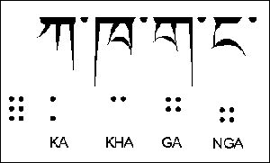
Part of the Tibetan Braille
script developed by Sabriye Tenberken in 1992 at the Friedrich-Willhelms
University, bonn, 1992.
|
Initially for her own use in
her study of Tibetology at Bonn university, Sabriye developed a Tibetan script
for the blind. This script combines the principles of the Braille system
with the special features of the Tibetan syllable-based script. This
script for the blind was submitted for close examination to an eminent
Tibetan scholar, who found it to be readily understandable, simple, and
easy to learn. As Tibetans until now had had no script for the blind, he
suggested to Sabriye that she let blind Tibetans take use of it.
|
First
step: preparatory school for blind children
In May
1998 Sabriye Tenberken (German) and Paul Kronenberg (Dutch) left Europe to
establish the Rehabilitation and Training Centre for the Blind, Tibet,
starting with the preparatory school for elementary school children. After
arranging all the necessary requirements, 6 children were collected from
different villages to board at the school. The children came from different
parts of the Tibet Autonomous Region and had to get used to each other's
dialects. A local teacher was found and within a couple of days she was
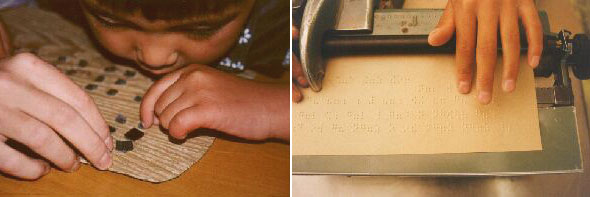
instructed in the Tibetan Braille script. The children learned the Tibetan
Braille alphabet on wooden boards with Velcro dots. They worked with
amazing enthusiasm and within just 6 weeks they knew all the 30 Tibetan
characters and were able to count in three different languages (Tibetan,
Chinese and English).
background
information on some of the children
Tenzin
Tenzin is 14 years old. He comes from a little village within the Lhasa
district. His parents are divorced, and he lives with his mother and his
little brother. Tenzin belongs to the few blind children who were
reasonably well integrated in his village. He has friends and had some
tasks. While his friends were attending school he took care of the village
yaks and goats. Through Medicines Sans Frontiers (MSF) Tenzin heard about
the Project for the Blind, Tibet. He wasn't used to washing every day and
the MSF-hygiene-trainers told him as a joke that only clean blind children
could attend this school. Ever since he obeyed the hygienic instructions to
wash daily. He was very
eager to attend the school. Tenzin is a very social and intelligent child,
who after only a few months learned to read and write the Tibetan, Chinese
and English Braillescripts fluently. When we asked him about future
profession plans, his answer was that he wants to study and he wants to
learn massage and physiotherapy. He started in this class in 2001.
Norbu
Norbu is 14 years old. He comes from a very remote little farming village
close to Shigatse. He has a little vision on his left eye, but not enough
to attend a regular school. Norbu is very playful and likes ball games or
just to run around. He is a fast learner and makes friends with other
children very easily. Norbu was trained in making cheese and is now working
as a trainer in the cheese factory.
Yudon
Yudon is 14 years old. She comes from a farming village close to Lhasa.
Being the youngest of six sisters and brothers she is very independent in
learning and playing. Yudon wants to become a teacher. In October this year
she was integrated into a regular school.
Chile
Chile is 13 years old. He comes from a village in the Drigung area, about
130 km north east of Lhasa. His parents are poor peasants. He has one
younger sister and within the village he has a lot of friends. He is the
comedian of the school and he loves to sing too. He entertains everyone
around him at all times, in all activities. younger sister and within the
village he has a lot of friends. He is the comedian of the school and he
loves to sing too. He entertains everyone around him at all times, in all
activities. He has been trained in the music class was integrated in his
village in the Oct 2003.
Metoq
Metoq is 15 years old and the oldest in the class. One day when she was 8,
she was playing in the fields with some friends when they found a grenade.
While playing withit, it exploded and she lost pretty much all her
eyesight. With the help of glasses she sees a little, but not enough to
attend a regular school. Her parents live north of Lhasa. Metoq is the
leader of the schoolclass. Early in the morning before classes officially
start, she lines up the other children and exercises the Tibetan Alphabet.
She is very neat and she is a great help for the housemother and father.
Tenzin Metoq was integrated in her home in Oct 2003. She wants to start a
shop together with her mother.
Staff
of the training centre
- A housemother and a housefather and a gatekeeper
are employed.
They take care of the children at all times, except when the children
attend classes.
- A cook prepares all the meals for the children and
the staff.
- Three teachers have been trained by Sabriye
Tenberken to teach the children the Tibetan, Chinese and English
Braille systems, and in addition they also teach mathematics,
orientation and daily living skills. An additional
English-teacher has been employed. He became blind through an
accident and was trained by the first three teachers.
- In autumn 2000 two blind massage trainers started
the massage and physiotherapy-training with two students. These
students now teach in the BWB centre.
- Since March 2001 a famous blind musician took over
the music-classes. He is training 4 talented students to become
professional singers.
- In 2002 one staffmember has been employed to
pruduce Braille school books.
Leisure time
- The children love to play ball games. The ball is
filled with a few rice grains or a small bell, so the children hear
where the ball is.
- Sculpturing tsampa is a very important way
of training the sensitivity of fingertips and hands. Tsampa is
the main traditional food in Tibet, it is made out of roasted barley
mixed with yak butter. It is also often used as a material to
mould sculptures.
- All of the children love to sing and dance. Now
they have also discovered the fun of playing musical instruments, such
as drums, flutes and bells. Apparently any instrument that produces a
lot of noise is welcome.
- The children regularly paint.
- The children like to write stories and like
to play theatre plays.
1.
Preparatory school for the Blind
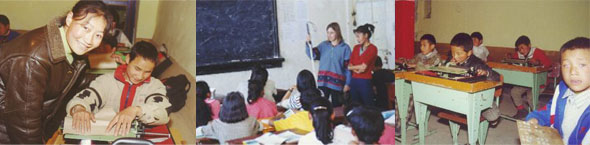
Since the population of blind people in the T.A.R. is very widespread, it
has been decided to have the blind children boarded in Lhasa and be trained
at the centre. From a financial, organisational and logistic perspective it
would simply be too complicated to set up an individual training program in
the very remote areas. With blind people boarding at the school, training
and education can be given much more effectively. Being taken out of their
familiar surroundings for a certain period of time, they have to adjust to
a new environment. This helps them to accept and learn the
techniques for the blind more easily. Additionally the blind have the
opportunity to communicate with other blind people and exchange experiences
and the problems they face in their respective home situations. During
their one or two years of training, they gain enough self-confidence to
cope with daily life independently. The preparatory school for the Blind
provides classes and housing for children aged between 5 and 15. The
training for the students lasts for one to two years. First the students
receive an intensive training in orientation, mobility and daily living
skills (orientation in a room / school compound, walking with a cane,
eating with chopsticks and daily hygienic skills) followed by a training in
the Tibetan, Chinese, English and mathematical Braille script. In addition
to the training of the special techniques for the blind, the students are
also taught in basic colloquial Chinese and English language skills. All
students who attend a regular school after a one or two year's training use
schoolbooks which are used in the first four elementary school classes. The
goal of the preparatory school is that after completion of the basic
training the young students integrate themselves into regular local
elementary schools.
2.
Vocational / skills training
The following are possible professions or skills that can be performed by
blind
people in the T.A.R.:
- Tibetan and Chinese medical massage, pulse
diagnosis, acupressure: The professions of medical masseur
and physiotherapist are within the PR China reserved for the
blind and the deaf. Two blind in Chengdu educated medical massage
trainers were found who started up this program in the autumn of
2000. In May 2001 , April 2002 and April 2003a blind
physiotherapist from Switzerland, Monique Assal, came to Lhasa to
train the trainees and one massage btrainer in the basics of
physiotherapy.
- Musical training: especially talented blind
students are trained by a professional musician in singing, composing
and playing musical instruments.
- Animal husbandry: Milk, yoghurt, cheese production
(Summer 2004)
- Agriculture: Cultivating vegetable and grain.
(Summer 2004)
- Handicrafts: Knitting, weaving, pottery, carpentry
, basket making. (Summer 2004)
- In the centre in Lhasa the students are trained in
the use of a computer.
3.
A workshop for the production of educational school materials.
To provide reading and working materials for the students attending the
school and the vocational training program, a workshop for the production
of Tibetan Braille materials has been established. A computer program to
convert written Tibetan into Tibetan Braille has been developed by a German
blind mathematician, Eberhard Hahn. Tibetan texts can be typed into a
computer through Wylie transliteration, and the program converts this
transliteration into Tibetan Braille, which is then printed in Braille. The
first Tibetan Braille books were produced in August 2001.
4.
Self-Integration Project
Only shortly after the project started it showed that the impact of the
project on the students was a very positive one. Children who came from
backgrounds in which they were completely excluded from society discovered
that they were not the only ones with a similar fate. The students were
able to share their experiences and they were confronted with blind people
who were able to perform different tasks and professions. All students were
treated the same. Within days the students grew stronger and also their
self confidence increased considerably. In case a student mentioned that he
couldn’t do a certain task, the teachers and staff of the project replied telling
them that the blind teachers or Sabriye was able to perform the task and
they also could not see. Within the project the students showed that their
increasing self confidence was a very important step to be able to face the
daily society. One day, a few of the students walked in the centre of Lhasa
and some Nomads very rudely shouted at them: ”Hey, you blind fools!!”.
Kienzen, the oldest of the small group turned around and told the nomad
that yes, he is blind but he is not a fool. “I am going to school, I can
read and write! Can you do that?”. “I can even read and write in the dark!
Can you do that?”The nomads were very astonished and of course they were
not able to write because they never visited a school. They started a
conversation and about 6 months later these nomads brought a blind little
boy from their region to the project. This small example shows how
important it is for the children to know that they are valuable members in
society. We want the students not to be embarrassed to be blind, they
should see it as a sort of quality. One person has big feet, another hasred
hair and some are blind. They should stand up in society and say, “I am
blind, so what!?”.
In the Tibetan society it is believed that blindness is a punishment for
something done wrong in a previous life. Because of a lot of media
attention in the TAR the project is being visited by lots of Tibetan and
Chinese people who are curious to see what is going on there. When they are
confronted with happy children they wonder how it can be that these
children are punished. It is the staff who tells them that these
children are not punished but they are challenged for their next life.The
visitors seem to be very open for this idea and suddenly they see the blind
with some more respect.
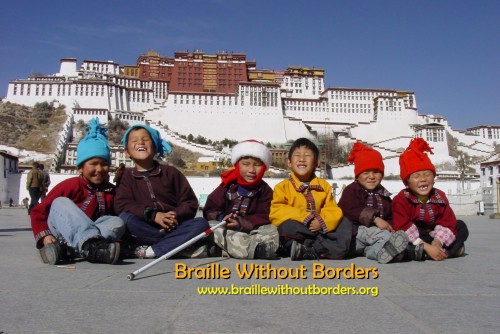
Initially
BWB planned to train special fieldworkers to counsel the students on a
regular base. In the beginning BWB received help from some Save the
Children staff members who were visiting the school nearly every week
anyway. However after a few months BWB noticed that the students were doing
really well and that they integrated themselves into their class and
school. BWB gave this some thought and realized that the process cannot be
called RE-INTEGRATION since the children have never been integrated before.
The process also cannot call it just INTEGRATION since what does that mean?
If you put blind students in a regular elementary school does that mean
they are integrated. What happens to them during the breaks? Do they have
friends? How do the teachers treat them? What about the surrounding
environment of the school? The trained blind students showed their
surrounding what they are capable of, where they need help and where they
are able to help the sighted children. BWB saw that they made a lot of
friends but also met some competitors in class which shows that the
integration is real and that the blind do not get a special treatment. BWB
therefore came to the term “SELF-Integration” to describe the
process. The children have a base of knowledge and most important enough
self-confidence to be able to
integrate themselves into the school, daily society and also into a
profession. Two students, Kyla and Digi, who followed the medical massage
and physiotherapy training, graduated in November 2003 and in December they
started their own clinic. Dorjee and Jampa, the twins start their own
teahouse. BWB is in touch with the self-integrated students on a regular
base to supply the studentswith Braille schoolbooks, paper and other needed
materials.
All
Contents Copyright ©2005 Braille Without Borders All Rights Reserved.
Web
site sponsored by National
Importers Inc.
Web
Design sponsored by Summa
Systems Ltd.
|